Toolbox Talks · Part 2 of 2
6 things your phone is taking from you, and how to take them back
No shame, no dumb-phone evangelism, no 5am routine. Just really basic things that worked for me and how long each one takes.
If you read nothing further: go turn off every notification except calls and texts. It takes 10 minutes, and the ROI on your attention is worth it. How to do it is at the bottom of the article.
Before we start
This is Part 2 of two, and you do not need Part 1 to get value out of this one. That was a walk down memory lane of my journey going from $50 Motorola coke phone that could do nothing to two work phones and a burnout that led me to viewing my phone as enemy number one, with stops at Bebo, MSN Messenger and the many ways we have used Facebook over the years. A nostalgic read, or a traumatic flashback if you also burned out post 2020 when video calls replaced everything. If you want to give it a read you can find it here.
A few key points worth repeating though. We have been on a long journey from an exciting little device that increased our connection with one another, one we only picked up when we actually wanted to talk to someone, to a device that is absolutely everything: our phone, our wallet, our boarding pass, the MFA to access half our accounts, our banking, our maps, our notebook. We have become so dependent and SO accessible, and we all know it does not feel great.
We also tend to hold a lot of shame about how we use our phones. That full body brace when the weekly screen time notification pops up. But these little boxes are built by some of the best-resourced attention engineers on the planet, and we are never going to out-willpower them. The shame belongs on the system that enabled this, not on individuals fighting apps designed to grab and keep our attention. In saying that, there is also nothing to gain from throwing your hands up, calling it the system's fault, and letting something keep chipping away at your wellbeing. Doing something to reclaim your power is always better than doing nothing.
These are the things that have actually helped me feel like a participant rather than a passenger. I have included the scary statistics, because learning them is part of what reminds me why it's so important to set some boundaries. It is much easier to turn off notifications when you know what each one is costing you.
Think of all of it as scaffolding. Same as giving up smoking or any other addictive habit, you need to remove the temptation and make it inconvenient to slide back. So initially you might need to go in harder than feels reasonable. The scaffolding comes down later once you have built the safe foundations.
You're an adult though. See which problems alarm you most and take only the solutions that actually fit your needs. Every suggestion has a time estimate next to it, so you can pick by what you can be bothered doing today.
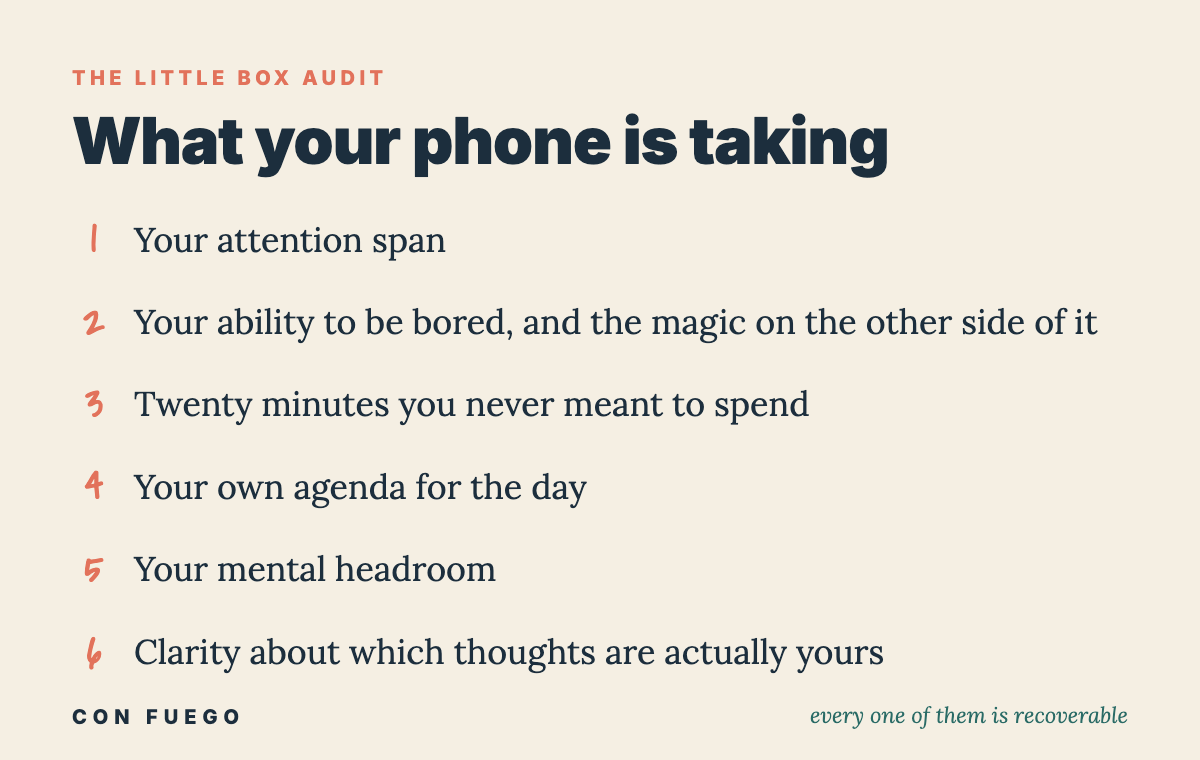
What is it taking?
- Your attention span
- Your ability to be bored, and the magic on the other side of it
- Twenty minutes you never meant to spend
- Your own agenda for the day
- Mental space
- Clarity about which thoughts are actually yours
1. Your attention span
Between short punchy videos that flood us with dopamine, constant easy distractions and flashing lights, we are losing the ability to hold focus and sit with longer form content.
Most adults check their phones somewhere between 50 and 200 times a day, and the research suggests it is the frequency of those checks, more than total screen time, that predicts memory lapses and broken focus. Which means you can have a respectable screen time report and still be fried, because you have been dipping in and out all day like someone opening the fridge every ten minutes.
Those little dips add up. It takes an average of around 23 minutes to fully refocus on a task after being pulled away from it. (I don't even know the last time I stayed focused for 23 minutes, at least not when there is a screen involved, even after working so intentionally to rebuild my focus.) You don't even have to look at the phone for it to cost you. Simply receiving a notification you do not open measurably drags your attention off what you were doing, and in one often cited study, having your phone merely present and face-down on the desk still reduced people's available cognitive capacity, even though they were not using it and did not believe it was affecting them.
Email is its own beast. In one experiment, people who limited themselves to checking their inbox three times a day reported significantly lower daily stress within a week, with no change to their actual workload. The growing to do list in your brain with impending sense of dread and urgency becomes more of a problem than the quantity itself.
What helps
- Turn off all non-essential notifications. 10 minutes, once. I keep calls, texts, banking and WhatsApp on, that's it (oh, and ride share apps). Instructions at the end.
- Use Do Not Disturb while you work. 30 seconds to set up, then one tap. You can still check whether anyone has tried to reach you. What it removes is the mid-flow-state interruption where someone asks about dinner and suddenly your brain is contemplating whether you want to go, what you will wear, and whether the food in your fridge is going to go off if you don't cook it tonight. Instructions at the end.
- Check email in blocks. No setup, just a decision. If your work allows it, pick three times a day instead of living with the inbox open. Not first thing, so you get some focused work done on your own agenda before it gets hijacked by someone else's.
- Put the phone in another room. Five seconds. Out of sight and out of reach, because even face-down on the table it is running a background script in your brain. And do you not want that air of superiority where you get to say "oh sorry, I forgot to check my phone" or "I genuinely do not know where my phone is"? It feeeeeeeeeels goooood. Not that it is a competition, but god you have to feel it at least once.
2. Your ability to be bored, and the magic on the other side of it
Do you remember being a kid at a family friend's barbecue, no devices, left entirely to your own imagination to stay entertained? Next thing you know you and the other miscellaneous kids have choreographed an entire dance routine and you get the glee of forcing everyone to watch the whole thing and cheer afterwards. Glorious feeling, not possible without boredom and having space to actually think about how to entertain yourself.
Last year my region had a cyclone and most of my suburb had no power for days. Everyone was forced to play board games, talk, and make things. Beyond the inconvenience of no fridge, limited cooking and patchy communication, I did not hear a single person complain about missing Netflix or social media. Everyone was like ahhhhh isn't this nice, and once the power was back we got a lot of joy sharing stories about the things our households did to keep entertained.
We used to have gaps for boredom to strike us all the time. Queues, waiting rooms, bus trips, ad breaks, the three minutes before a meeting starts. Every one of those is now filled. Why just sit waiting when you could stare at the little box in your hand?
When you are not actively focused on a task, your brain switches into what neuroscientists call the default mode network. That is where memory consolidation happens, where recent experience gets stabilised into long-term memory, where you make sense of things, where you plan and imagine and problem-solve without trying. It is your brain filing the day. If you never stop feeding it new input, it never gets time to file things neatly away. I picture my brain minions frantically running around drowning in paper files, and when they actually need to find something it takes a deep dive and five times longer than it otherwise would have.
Boredom also appears to be genuinely useful for creativity. In a set of studies, people made to do something extremely boring first (copying numbers out of a phone book) went on to generate more creative ideas than people who went straight to the creative task. When the boring task was made even more passive, reading the phone book instead of copying it, the boost was bigger still. The researchers reckon it is the daydreaming space that does it.
Every time we reach for the phone to fill fifteen seconds of nothing, we are waving goodbye to that filing time.
And when we grab the phone in every waiting moment and every social situation, usually to avoid the discomfort of accidentally making eye contact with a stranger, we miss all the good stuff. The world is wonderful. Connecting with strangers is always an unexpected delight. Sit back and watch the beautiful weirdos all around you on the train and let your mind wander, instead of watching strangers on your phone. At the airport, watch the goodbyes and the reunions and let your heart fill right up. People write beautiful cinematic scenes about that stuff, why not soak up the real thing while sitting there instead?
What helps
- Leave your phone at home when you do not need it. Costs you nothing. Quick trip to the shops. A walk for the sake of a walk. The Sunday morning mosey to the coffee shop.
- Ban yourself from your phone in queues. Cost, a lil bit of discomfort. Look around instead. No one is watching you, they are busy looking at their own phones. If you are lucky you'll make eye contact with someone else looking around, you can share a conspiring smile of recognition. "Hello, fellow human who is present in the current moment, I am both surprised and delighted to see you here."
- Let the gaps stay empty. Costs you nothing, has long term benefits. No podcast for at least part of the walk. No scroll in the waiting room.
Please, for the love of god, prioritise this. Stop missing out on the moment and the place you are actually in. The universe is conspiring in your favour and throwing opportunities, connections and wonderful things your way. If you are filling every second by giving your attention to a screen, you are going to miss them.
3. Twenty minutes you never meant to spend
Your phone is your alarm clock, your camera, your bank, your map, your boarding pass, your torch and your notepad. Which means you have to pick it up constantly for entirely legitimate reasons. And that is precisely where it gets you.
You unlock it to check the weather and resurface twenty minutes later having not checked the weather.
That is not a reflection of our focus or willpower. It is a design feature. Research into phone habits has consistently found that most pickups are not prompted by notifications or genuine need at all. They are habitual, triggered by an internal state like boredom or discomfort rather than anything happening on the device.1 The habit is the product. And the numbers on how fast we move once we are in there are bleak: the average time we now spend on one screen before switching to another is about 47 seconds.2
The encouraging news is that very small amounts of friction work disproportionately well. In a six-week field experiment with 280 participants, an app that simply intercepted the launch with a brief pause and the option to back out reduced actual app openings by 57%. So instead of trying to miraculously find more discipline, we can just add a little speed bump.
What helps
- Buy a cheap alarm clock. Five minutes and under $20. Then the phone is not the first and last thing you touch every day.
- Aeroplane mode overnight. Two seconds a night. If the phone has to be your alarm, at least you won't be tempted to peek at the notifications in the morning or if you check the time when you wake up in the middle of the night.
- Switch to greyscale. Two minutes to set up, worth roughly 38 minutes a day. Makes your phone feel icky to look at. Instructions at the end.
- Get the time-sink apps off your home screen. Five minutes. Just delete from the home screen so that opening them isn't just muscle memory.
- Use an app blocker when you are in a rut. Ten minutes to set up plus a small price. This is more like a boom gate, takes more than slowing down to get around it. Instructions at the end.

Subscribe to get more articles like this straight to your inbox.
Subscribe4. Your own agenda for the day
Around 85% of people check their phone within ten minutes of waking. Before you have worked out how you feel, what you need, or what you want from the day, you have been handed everyone else's priorities: the news cycle, your inbox, whatever the algorithm decided you should see.
Mornings are when I can hear myself most clearly, before I take on the outside world. And there is decent evidence for what that noise does. Compulsive consumption of negative news is associated with higher psychological distress, existential anxiety and lower life satisfaction, and there is evidence it shifts how pessimistic people are about human nature in general. It doesn't just make you feel bad for ten minutes. It seems to adjust the lens.
If you go to social media first, you pick up whatever mood the algorithm serves you that morning. If you go to your inbox, you let whatever landed overnight decide your priorities before your own brain has had the chance to.
What helps
- Block social media and news until mid-morning. Two minutes, if you already have a blocker. So you cannot reach for them before you have started the day your way. Instructions at the end.
- Charge the phone outside the bedroom. One minute, then a nightly habit. Requires the alarm clock from the section above.
- Start with something that is yours. However long you give it. A walk, a coffee outside, ten minutes of writing, whatever it is. Once I have done that, the rest of the day holds better. Personally, if I start with a scroll hole I'm drawn to my phone 3 times as much throughout the day.
5. Your mental headroom
Just like a messy bedroom makes for a messy brain, the phone is somewhere you spend a lot of time, so it needs the occasional clean-out.
I know there are people out there living happily with 4,000 unread emails and a little red circle on every app. If that is you, congratulations, genuinely, skip this one. I cannot function like that.
Multiple things in your visual field compete for representation in the visual cortex by mutually suppressing each other's activity, which is a neuroscientist's way of saying that the more stuff there is on screen, the harder your brain works to pick out the one thing you were actually looking for. Every badge, every icon, every unread count is a small unresolved thing your attention has to push past.
What helps
- Unsubscribe from every email that offers no value. 20 minutes for a first pass, then 10 seconds each time one sneaks in. Redo it every few months, because they mysteriously resubscribe you. WTF is that about, by the way. Instructions at the end.
- Delete the apps you do not use. 10 minutes. If you have not opened it in a while, it is not earning its place. This also frees up some space for more photos, yippee.
- Clear the home screen down to essentials. 10 minutes. Everything else goes in the app library or a folder two swipes away.
- Turn off badge counts, not just notifications. 5 minutes. Silencing an app still leaves the little red number sitting there grabbing your attention. Instructions at the end.
6. Clarity about which thoughts are actually yours
We take on the thinking patterns of whatever we spend time with. If you listen to the same person every week for a year, they are functionally a friend, and their framing starts to become your framing. It's just how we work as people, we have always absorbed the people around us. The difference now is that we do not choose them, an algorithm does.
The clearest example is the manosphere lads. When you find yourself in a conversation with one, you can spot it immediately, because they spout the same vitriol almost word for word and when you ask a question they struggle to answer because the thought isn't actually their own. It is herd thinking. It arrived because they were fed the same content until it felt like common sense. The same machinery runs the wellness rabbit holes and the hustle-bro finance feeds. Different tribe, same mechanism: a worldview installed by repetition until it feels like your own conclusion. We're all susceptible to it.
It is absolutely worth engaging with things that do not align with you. That is how critical thinking gets exercised and how a mind stays open. But there is a difference between deliberately engaging with a challenging idea and marinating in someone's worldview several hours a week without realising.
What helps
- Audit your sources. 10 minutes of honest thinking. If you are consuming news, consider who owns it, what their bias is, and whether it is delivered in a way that incites fear or gives you a balanced read.
- Audit the voices. Ongoing. If you listen to the same podcast every week, ask whether those values are ones you want seeping into yours. Not whether you agree with everything, but whether you would want to think like them in five years.
- Ask why you are drawn to it. A few seconds, any time you notice yourself hooked. The most useful question I have found. If something is making an insecurity of mine feel seen, but doing it by vilifying other people, that is not the balm it is pretending to be.
- Cull who you follow. Ongoing. Notice how you actually feel after consuming someone's content. There have been creators whose work I loved and bought from, then felt the misalignment and stopped, and then found myself back as a customer years later. It is allowed to change.
- Train the algorithm. Seconds at a time, forever. Tell it what you do and do not like, every single time. It is the highest-leverage habit here and it is worth its own section. Instructions at the end.
Choosing where the energy goes
The other half of this renegotiation was not about defending my attention. It was about choosing where to spend it.
These days I spend my time where there is a higher cost of energy to engage. If a piece of content takes ten seconds to consume and it is full of flashing lights and dopamine, the comments it receives will have had about the same amount of thought put into them. To me, that is noise. Sometimes I like the noise. If it is cute or funny or creative and leaves me smiling or inspired, I fucking love it.
This is why I like Substack, because if someone is going to invest fifteen minutes reading an article, you know that by the time they comment, they have actually got something to say. They aren't commenting for commenting's sake.
Minus, of course, the sprinkling of people here chasing growth hacks, who you can spot from a mile away commenting to drive their own engagement rather than to genuinely connect. Kind of like back at uni, when you had to reply to classmates' blog posts for a grade, and everyone did the bare minimum ten minutes before it was due, before we headed to the uni pub to talk about the things that actually interested us.
So this is my newest challenge: working out a new platform, and how to build an environment here that stays meaningful and aligned. How to reach the people I am writing for, who are essentially me of five years ago, without contributing to noise that helps no one. And how to train my algorithm here to fill with the optimistic minds that inspire me and constantly remind me how wonderful it is to be a speck floating on this rock.
The toolkit
Every "how to do it" link above lands here. I am on an iPhone, so these are iPhone paths. Android has an equivalent for every one of them, usually somewhere under Settings, then Notifications or Apps.
Turning off notifications
10 minutes, once.
On an iPhone: Settings, then Notifications. You will see every app you have ever installed listed underneath. Work down the list and turn Allow Notifications off for everything that is not a human trying to reach you or essential to have timely notifications from.
Be more ruthless than feels comfortable. Nothing bad happens. The apps still work, you just visit them on purpose instead of being summoned.
Do Not Disturb
30 seconds to set up, then one tap whenever you need it.
On an iPhone this lives in Focus. Settings, then Focus, then Do Not Disturb. You can allow specific people through, which is the bit most people do not realise, so if you have kids or someone unwell you are still reachable.
Then swipe down from the top right to turn it on and off from Control Centre.
Greyscale
Two minutes to set up.
When the phone is feeling a little too alluring, I turn this on and it helps. You just do not want to look at a grey screen. There is decent evidence behind it too: in one study, students who switched their phones to greyscale cut their screen time by around 38 minutes a day, and later studies found reductions between 20 and 50 minutes.
On an iPhone:
- Settings, then Accessibility, then Display & Text Size, then Colour Filters
- Turn Colour Filters on and select Greyscale
- To make it a one-tap toggle: back to Accessibility, scroll to Accessibility Shortcut, select Colour Filters. Now triple-clicking the side button flicks greyscale on and off whenever you need it.
Badge counts
Five minutes.
Separate from notifications, and the one people forget. In Settings, then Notifications, tap an app and turn Badges off. That is the little red number. You can leave notifications on for something and still kill the nagging red dot, which is useful for apps you genuinely need but do not want counting at you.
Unsubscribing from emails
20 minutes for a first pass.
No clever trick here, just a system. Search your inbox for "unsubscribe" and work through what comes up. Most email apps also now surface an unsubscribe link at the top of marketing emails, so the ongoing version is ten seconds each time one arrives.
The trick is doing it in the moment rather than archiving and telling yourself you will deal with it later.
App blockers
Ten minutes to set up. I use Opal.
Sometimes when I am in a rut it seems easier to stay there with a scroll hole. If I am going through a stage like that, I block the attention-sucking apps in the mornings so I cannot reach for them. Usually once I have started the day with things that make me feel good, I am fine to carry on.
Your phone almost certainly has a version built in, and if that works for you, brilliant, use it. For me they stop working almost immediately, because they become invisible. The limit pops up, I tap past it without thinking, and I have not actually made a decision at any point. I need something I cannot bypass, or that at least makes bypassing it annoying enough that I notice myself doing it.
This is the scaffolding I mentioned at the start. I do not run blockers permanently. I put them back up when I notice I am slipping, and take them down again once the habit has settled.
Treating the algorithm like a bad relationship
Seconds at a time, forever.
Let's stop treating the things on the internet as something that is happening to us instead of something we are an active participant in, let's try treating the algorithm like a bad relationship. You have gotta set your boundaries, and you have gotta encourage and reinforce what you do like. If things start to change, why not stay? And if things stay shit after you have said "hey, I don't like this", then adios, motherfucker.
In practice:
- If you really like something, interact.
- If it is whatever, scroll on by without engaging.
- If it elicits shame, disgust, or a need for self-soothing, unfollow, block, or hit "don't show me content like this anymore", whatever matches the response it got from you.
Content telling me my body is not good enough gets a "not interested" every time, and if the platform keeps serving me skinnytok anyway, I am out of there. Same for anyone building a following on rage bait. That content grabs me, that is the entire point of it, but grabbing me is not the same as being worth my attention. I would rather something smaller fry.
I am still fucking creeped out by an algorithm knowing what interests me, where my eyeballs go, how I respond to things though.
The three things rule
Costs nothing, works about half the time.
Before I let go of my personal Instagram entirely, I had a rule: I could stay for three things that made me pause, that I genuinely got value from, and then I was done. I wrote each one in a note on my phone, and after the third I was finished for the day.
It started as me justifying my scroll holes to myself, "ohhhh but I'm learning things". I enjoyed having a channel for new things to enter my bubble. But after a few things that make you pause and take value from, after that you're just consuming, nothing is sinking in.
I forgot about the rule as often as I remembered it, but it was a genuinely fun scenario to run, and it is the tip I would give someone who is not ready to leave a platform but knows something needs to change.
A sample of some of the things in my notes app that don't require heavy editing to make sense:
- chicory root tastes like coffee?? Remember for next coffee detox
- you don't one day feel ready to start putting your messaging out there because you are no longer scared, it's just that you are prepared to start showing up in the face of discomfort
- Ayurveda says banana and yoghurt bad together, FACT CHECK
- make chrysanthemum tea jelly!
- don't hate the players, change the game, Liv Bourne
- Increased serotonin = less reactivity. Doing the human things increases serotonin (sunlight, exercise, sleep, huuuugs)
Where I have landed
It is fucking hard to get through life without our phones, and they do have real value. Unless all of society gave them up at once, in which case we would all be lost 85% of the time, bumbling around like idiots while we relearn the basic skills we have outsourced.
There is no point criticising and shaming ourselves or each other for how we interact with them. And there is absolutely nothing to gain from throwing shade at younger generations who have formed an entirely different relationship with tech that you cannot understand. Telling kids about back in your day, when you are 45 and it was not all that long ago, helps nobody. They grew up in a different world. Just like your parents telling you about back in their day did not do shit.
So let us accept that our attention has become a product, and let us claw back a bit of control over how it is farmed from us.
And here is the thing about that screen time number you brace for every week: it is a flat metric that tells you almost nothing. The largest study in this area, covering more than 350,000 adolescents, found technology use explained at most about 0.4% of the variation in wellbeing, a smaller association than regularly eating potatoes. Other researchers have argued that analysis flattened real effects, particularly for girls, so it is genuinely contested. But the useful takeaway holds either way: the raw number of hours is a rubbish measure on its own. What matters is what you are doing, when you are doing it, what that time is replacing, and how it leaves you feeling.
So think about those four things instead. If you feel sweet about how you have been using it, fabulous, tally-ho, carry on. If you do not, then stop feeling bad and doing nothing about it. You are the captain, so act like it.
The system is still cooked. Nothing on this list changes that, and I want to be clear I am not offering personal responsibility as a solution to a structural problem. There are people with the right kind of smarts working on data, safety and regulation, and I am not one of them. But none of that means you have to sit inside a relationship that is making you feel like shit while you wait for the world to fix itself.
The only thing I will push you on is the maintenance. Every one of these boundaries erodes with time. Brands resubscribe you to emails you unsubscribed from months ago. App updates quietly switch your notifications back on. The algorithm forgets what you told it, or decides to test whether you meant it. The accounts you followed two years ago are growing and changing humans or brands too, so what resonated then might not fit anymore. And you change what you need.
Treat it like weeding, not like building a fence.
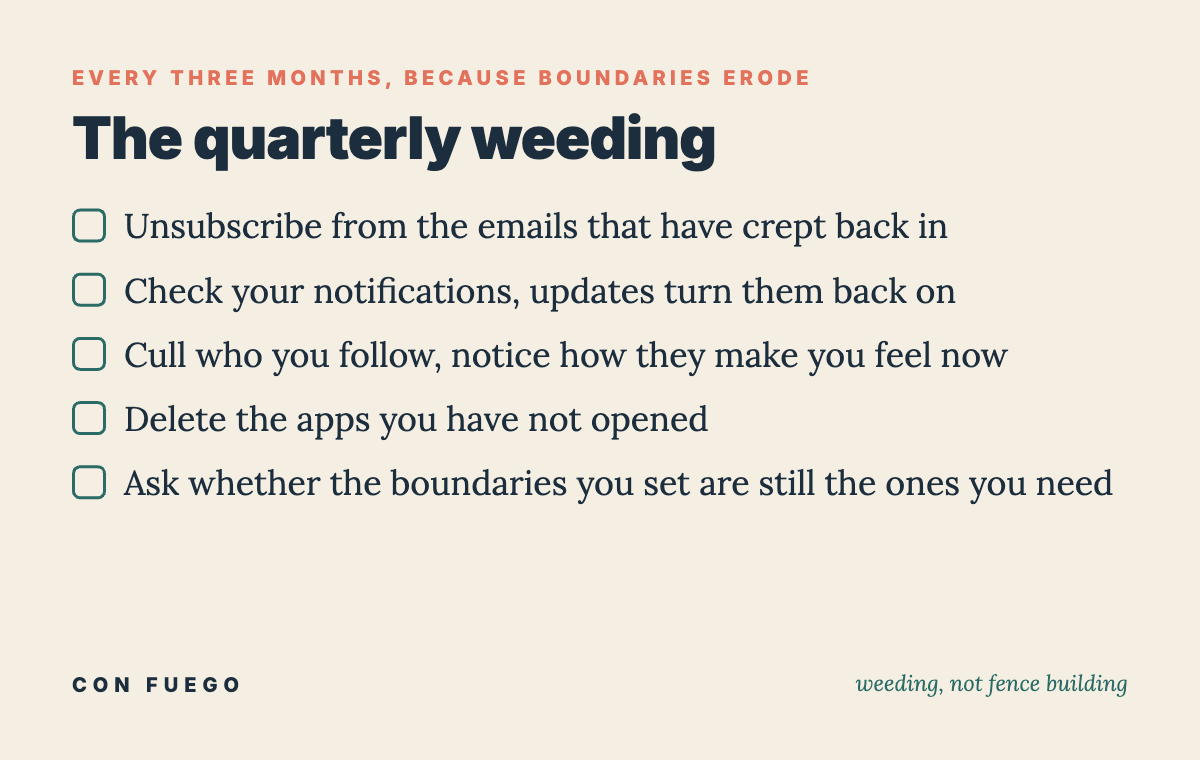
I do not schedule my clean-outs. They tend to happen organically when I notice I am feeling overwhelmed, which is usually the signal that things have crept back. But if you are someone who needs the prompt, put it in your calendar. Genuinely. A recurring one every three months that says:
- Unsubscribe from the emails that have crept back in
- Check your notification settings, because updates turn them back on
- Cull who you follow, and notice how they make you feel now
- Delete the apps you have not opened
- Ask whether the boundaries you set are still the ones you need
If you have cracked any part of this, or you are mid-renegotiation with your own little box, I would love to hear about it. If you have other hacks that work, share them in the comments for anyone else.
Subscribe to get more articles like this straight to your inbox.
SubscribeReferences
- The Washington Post's 2025 review of phone-checking research, drawing on Larry Rosen's studies and Singapore Management University findings on check frequency and cognitive lapses, plus research on habitual versus prompted pickups. washingtonpost.com
- Gloria Mark, professor of informatics at UC Irvine. The 23 minutes and 15 seconds refocus figure comes from her workplace interruption studies ("The Cost of Interrupted Work", 2008); the 47-second average is from her 2023 book Attention Span. informatics.uci.edu
- Stothart, Mitchum & Yehnert (2015), "The attentional cost of receiving a cell phone notification", Journal of Experimental Psychology: Human Perception and Performance, 41(4), 893-897. doi.org/10.1037/xhp0000100
- Ward, Duke, Gneezy & Bos (2017), "Brain Drain: The Mere Presence of One's Own Smartphone Reduces Available Cognitive Capacity", Journal of the Association for Consumer Research, 2(2). journals.uchicago.edu
- Kushlev & Dunn (2015), "Checking email less frequently reduces stress", Computers in Human Behavior, 43, 220-228. sciencedirect.com
- On the default mode network, wakeful rest and memory consolidation. sciencedirect.com
- Mann & Cadman (2014), "Does Being Bored Make Us More Creative?", Creativity Research Journal, 26(2), 165-173. doi.org/10.1080/10400419.2014.901073. Plain-English summary: sciencedaily.com
- Grüning, Riedel & Lorenz-Spreen (2023), "Directing smartphone use through the self-nudge app one sec", PNAS, 120(8). doi.org/10.1073/pnas.2213114120. Worth knowing: one of the authors is the app's creator, so read the result with that in mind. The underlying principle, that friction reduces automatic behaviour, is well supported elsewhere.
- Reviews.org annual cell phone usage survey, 2026 edition. reviews.org. Around 1,000 US adults, self-reported, so treat it as a rough indicator rather than a precise figure.
- Shabahang et al. (2024) on doomscrolling, existential anxiety and pessimism about human nature. sciencedirect.com. See also the Mental Health Foundation's summary: mentalhealth.org.uk
- McMains & Kastner (2011), "Interactions of top-down and bottom-up mechanisms in human visual cortex", Journal of Neuroscience, 31(2), 587-597. doi.org/10.1523/JNEUROSCI.3766-10.2011. This is lab research on visual competition, not a study of phone home screens, so treat the application as a reasonable extrapolation rather than a direct finding.
- Holte & Ferraro (2020), "True colors: Grayscale setting reduces screen time in college students", The Social Science Journal. doi.org/10.1080/03623319.2020.1737461
- Orben & Przybylski (2019), "The association between adolescent well-being and digital technology use", Nature Human Behaviour, 3, 173-182. nature.com
- Twenge, Haidt, Joiner & Campbell, "Underestimating digital media harm", Nature Human Behaviour. nature.com