Toolbox Talks · Part 1 of 2
Why you can't put your phone down (and why that isn't your fault)
The slippery slope from a $50 Motorola to needing to renegotiate terms with my phone after 21 years of increasing 'connection'.
I don't need to tell you how constantly we're bombarded with information, notifications, hot takes, advertising and other people's opinions, or what it's all doing to our attention spans, our relationships, our dopamine, etc. etc. The fact that we're meeting on Substack tells me you likely have the same aversion I do.
I'm 33 and I grew up alongside technology; as the culture shifted and changed with each new app, I was along for the ride. From spending HOURS coding my Myspace page and ruthlessly reordering my top friends, to this current era of feeds filled with content from accounts with millions of followers that turn out to be AI generated "people".
Somehow between then and now the little box in my hand went from a place that I visited to a thing that follows me around demanding constant attention. Slowly the boundaries slipped on how it interacted with my life, kind of like an unhealthy relationship where one day you wake up and go WTF how did I get here. All of a sudden my phone felt suffocating and I desperately needed space. I go through cycles, and when I tip too far over, I become unreachable even to the friends I genuinely want to hear from. It's not them I'm hiding from, it's just this visceral aversion I have to that pesky little device.
The little box in my hand went from a place that I visited to a thing that follows me around demanding constant attention.
This is a reminder to myself, and perhaps to you, that we can be active players in what we consume and how much access it has to us. This is Part 1 of a two part piece. This is more a trip down memory lane of the social development of mobile phones and an acknowledgement of how we got here, the most connected we've ever been while simultaneously the most disconnected. It all depends on how we define those words after all.
In Part 2 I'll share the things that have actually helped me shift the relationship to something that feels manageable, and the reasons I'm not just rushing out to get a brick phone or hide deep in the forest as I sometimes feel inclined. I haven't cracked the code, it's a never ending renegotiation of terms, but at least I feel like I am actively participating now.
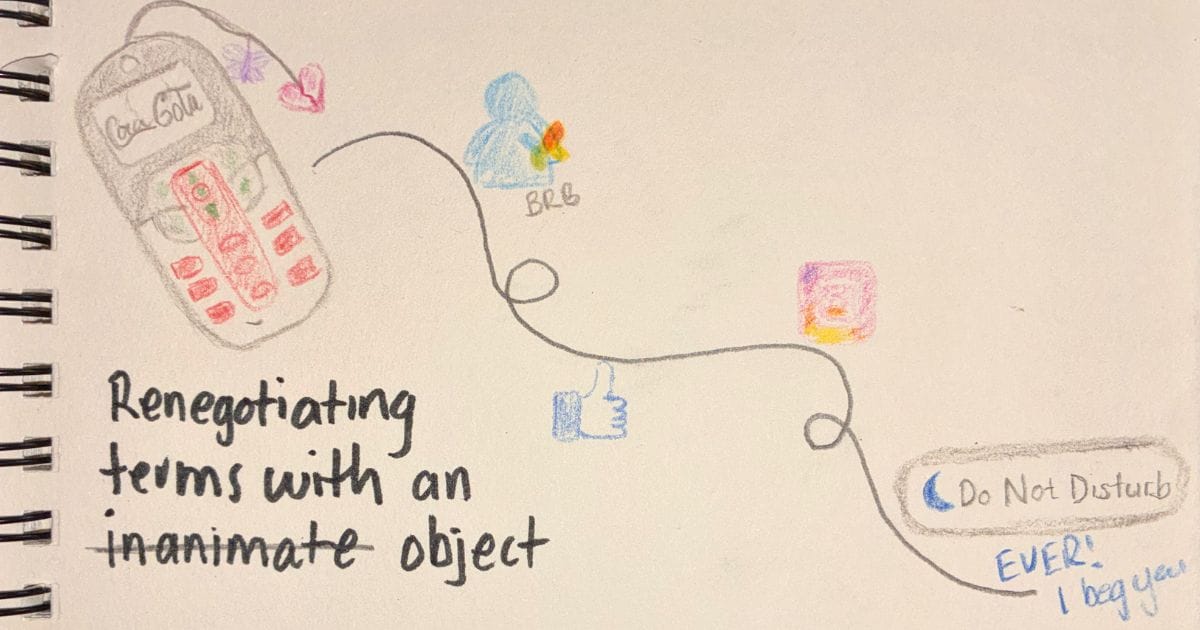
What growing up alongside the mobile phone looked like for me
I was 11 when I got my first phone. Young for 2005 standards but apparently the average age now. It was a $50 Motorola that came with some sort of Coca-Cola promotion. Text messages were 25 cents a pop, phone calls were charged by the minute, and it had one shitty game that sadly was not Snake. That's about all my sweet phone could do. I was way ahead of my friends in getting a phone, and I only got it because I had separated parents and was heading off on a six-week road trip with one of them. There wasn't really any status amongst my peers of 11 year olds in having a phone back then, and because Mum was my only contact, it didn't exactly excite me or feel cool. It was just the pesky thing that meant I had to stop playing to take a phone call. (Now that I'm looking back, maybe the aversion has partially been my personality all along.)
From there, I grew up alongside technology. I experienced the era of dial-up internet, where someone screams "Casey, get off the internet, I need to use the phone!", rushing home from school to chat to my friends on MSN, and spending endless hours redesigning my Myspace page to best reflect my angsty teenage mood of the moment. There was Piczo and Bebo, which both feel like a fever dream now; I have a vague recollection of photos with glittery text overlays. Then came Facebook, where our every thought was posted as a status and a single night out warranted an album of 112 photos. God, somewhere in all of that we used to pay $5 to text 'Ask Bongo' someone's full name, their town and a question, and get back a reply that was sometimes vague and sometimes creepily accurate. Before we had constant access to the internet, it seemed like the most effective and reliable way to find out who someone had a crush on. Up until this point, none of it really felt performative, at least not in my memory. Maybe that was partially my age, but it felt like people actually just showed up as themselves. The full body cringe when those early Facebook memories pop up confirms I definitely had not learned how to polish an online persona yet. Then in came Instagram, Snapchat, and the list goes on. These seem recent enough that I'll spare us all the recap.
Now we go online and no one knows what's real and what's not. No need to fear an email from a Nigerian Prince claiming they have an inheritance for you as the dodgiest thing on the internet. Now we've got AI-generated "people" hawking supplements that supposedly transformed their lives. How did we so quickly get from paying $5 to ask Bongo who had a crush on us, to being sold magic pills by bots with fabricated relatable backstories designed to prey on our insecurities? If this world is new to you and you feel like feeling outraged check out this piece Robin Levine Shobin over at Charlotte's Book recently wrote about it, Meet All The Middle Aged Women Who Don't Exist.
Throughout this evolution of the ways we connect through our phones, and the culture shifting within and around these platforms, it all moved so fast that I was just passively riding the train, evolving with the beast. And that's just my personal life and phone. The addition of the work phone is a whole different kettle of fish.
Growing up, I watched my mum with her work phone and calls, and built this idea that being busy, stressed and always accessible was some form of status to aspire to. So unsurprisingly, once I was a grown-up out in the big wide working world, I relished having a work phone and receiving calls, emails and Teams messages. Fabulous, I thought. The adults with adult jobs need something from me. I am important. Great success!
Fast forward ten years into my career. I have a personal phone where, whenever I look, notifications are coming in from numerous social media channels, emails are flooding in from every store I've ever bought something from online, and there are eight message threads with actual friends and four group chats stacking notifications quicker than I can keep up. So, I'm ignoring it all, because everything on the little box is overwhelming.
Sitting right next to it is the work phone, where even more emails are constantly flooding in, only these ones really are a to-do list, in that if I ignore them the way I've ignored my friends and family, the overlords who pay me will stop doing so.
The email inbox to do list gets harder to tolerate once the shine of feeling important wears off and I realise what it's actually comprised of:
- 50% emails taking up space in my inbox for the sake of it
- 20% actually important for me to do my job
- 30% things I need to act on, even though bothering me with them could have been avoided entirely
Then we also add on the work calls and messages that genuinely need a response within a certain timeframe. Fortunately, at this point I'm in a job where I spend a lot of time in face-to-face meetings scattered across the state so I am on the road, a lot. The notifications on the little box don't bother me too much, because I'm achieving my job through interactions that don't depend on it. My value is not in how I manage an inbox, it's in how I build relationships and collaborations within the communities I am paid to serve.
Cue COVID.
All the time I used to spend connecting with people and building relationships in the informal moments where the real magic happened outside of the formal meetings, now appears as available time in my calendar. Suddenly I have Teams meetings scheduled for six to eight hours of every single day, and everyone knows I'm at my screen, so the emails and chat notifications keep flooding in. While I'm sitting there looking at two-dimensional faces on my medium screen, in meetings that are:
- 50% just being there for the sake of it
- 20% essential to me doing my job
- 30% could have been an email or resolved without me if I weren't so accessible
I'm watching notifications pour in on the little screen that follow the exact same split. Because everyone knows half the meetings are just for the sake of it, the expectation is that you'll still be responding even when the calendar shows as busy. Now we all sit there half listening, smiling and nodding while responding to Teams messages and constantly triaging our inbox for which lucky things will be done in the remaining 30 minutes of work day that has not been consumed by meetings.
Sorry for the reminder if you also went through the post rona burn out. Sharing the pain might help.
After that extreme became the new normal, my phone became something to fear. Something to be overwhelmed by. Something always demanding things of me. I was burning out rapidly, so when I wasn't at work, I swung to the complete opposite end of the scale by becoming completely inaccessible through the little box, personal and professional. The little box is now enemy number one. Unless of course I was scrolling happily on Instagram to avoid something more important, far too busy or drained to respond to my messages, but somehow with enough capacity to consume enough random information and opinions to feed my brain for a month all in the space of 90 minutes.
I became the person that friends don't expect a reply from for five to seven business days. When I still had a personal Instagram, my posts were often six months behind the actual event. No one ever knew where I was, or what I was doing, and for a while, that served me very well.
But I don't want to be a person who doesn't have the energy to get back to her friends. I love the people who have my number and contact me directly, and of course I want to get back to them quickly. I want to hear their voices, know what's happening in their lives, the big and also the mundane. I would beat myself up a lot for taking so long to respond to people (to be honest I still do).
But I have since worked out it was never the connections I had an aversion to. It was always the device.
If this resonates so far, my future posts might just be for you. Subscribing is free for you, and VERY encouraging for me.
Subscribe for freeBut with the bad, also comes good
Sure, the antidote to all of that could be to go down the dumb phone route. Reclaim my peace by having no other option, or take my other well-worn alternative of just ignoring my phone completely. But the silly little box actually does serve me well.
Now that I've talked so much shit about it, let me tell you why, to me, it's worth trying to repair this relationship into something that works.
- Easy communication with friends and family all over the world
- Facebook Marketplace has done me many a solid, as has Depop and anywhere else you can buy second hand.
- Facebook groups too, especially when travelling to remote towns in foreign countries, where you can organise carpooling, get travel advice, and often find the only reliable source of information or help.
- Similarly, Facebook community pages keep me updated on what's going on locally. Reading their comments also reminds me of the diversity in my communities, outside the bubble I live in, and it's a good place for a chuckle when I'm bored.
- I no longer have a personal Instagram, but I do have to appreciate the way it served as a manifestation board for me at times. Years ago, without realising it, I filled my feed with women living the life I was dreaming of. They had positive mindsets, beautiful supportive friendships, lived active outdoor lives filled with camping trips and group surfs, and they just oozed 'fuck yes for life' energy. I didn't do it intentionally, but a couple of years later I realised I was living the life that had been my Instagram feed.
- I learn fun and random facts that inspire me or send my curiosity down a rabbit hole. This has led me onto all sorts of new hobbies like making my own skin products, finding great recipes, motivating me to relearn how to do a handstand, bringing my awareness to new places to travel.
- It lets us peer into lives we otherwise never would have seen and opens our minds to what's possible. Sure, some of it is fake, but there's something real in expanding what you believe is possible.
- Begrudgingly, there are the ways it's almost essential, for multifactor authentication, online banking, ride sharing apps. These aren't essential, essential, but after watching a friend struggling to navigate life with a dumb phone for six months I realised some of the conveniences are too good in this current world.
My current era with the little box in my hand
I'm a believer that money is energy. While we can't single-handedly change the world, if something doesn't align with our values, we don't have to direct our money there. I've walked that path for a while now of being intentional with where my money goes and where I show up in person. All in all I'm pretty intentional with my energy.
And attention is energy too. So why was I spending mine like it was free?
I've long held the belief that we can actively change what we don't like, but for some reason, until recently, that mindset never transferred over to my phone.
So we're finding a happy medium, the little box and I. Like a once dysfunctional relationship that I'm trying to make work, I'm setting boundaries with an inanimate object. Although it's not really inanimate anymore. It comes with intelligence. Artificial intelligence, sure, but intelligence all the same, which means it can learn what I do and don't like, what I will and won't respond to. So now whenever it comes to something with an algorithm I'm encouraging what I like, and aggressively saying no to what I don't, and constantly checking in with myself on whether the new boundaries are actually working for me.
Step 1: Letting go of the shame and blame
These little boxes and the apps within them are designed by some of the best-resourced attention engineers on the planet, we never stood a chance. There are people and now entire AI systems out there who specialise in studying our every interaction, how our eyes move, what grants a reaction, and then exploiting that information for commercial gain. I think it's really important, like all broken systems, that we acknowledge first and foremost just how it's rigged against us.
It's very easy to place the blame on ourselves and one another for how we use tech. Older generations loving to talk shit on the younger generations who have had a different formative relationship with it that they can't relate to so therefore criticise with ease.
We tut with judgement at silly kids who are glued to their phones, parents letting their kids watch YouTube at a restaurant, or people outsourcing their basic problem solving and creativity skills to AI (let me be clear, I am guilty of all of the above, often). What if instead we directed those tuts at the system and the corporations that have gotten us here and are profiting on our dependence and chipping away at the humanness of our world? What if that energy that goes into bickering and judging each other online went into talking about how we can claw things back?
We shouldn't be shaming ourselves or one another for the predicament we are in, but similarly there is nothing to gain from saying 'oh it's the system' and accepting something that is impacting your own personal wellbeing and doing whatever you can to reinstate some autonomy. Something is always better than nothing.
There are things that we can do on the individual level that do help us to renegotiate that relationship, not enough to backspace on the damage that has been done. Somewhere out there are the people with the right kinds of smart to advise how we navigate the current era of protecting our data and our safety, I am not one of them (if you know them though please link their work in the comments). But I do have plenty of tips on how we can wrestle back a little bit of day to day control on how the little box makes us feel.
This walk down memory lane ended up much longer than I expected so Part 2 will be filled with the actual practical things that have helped me to feel like I have some control in this toxic relationship again.
Subscribe to get more articles like this straight to your inbox.
SubscribeSomething happened in writing this piece where I seemed to have gone back to each stage, I've listened to "Hate Me" by Blue October at least 30 times this week and I've replaced the craving of getting lost in a Myspace redesign with colouring my little cover picture while singing along to my old emo playlists with my whole heart. I haven't responded to a non-urgent message in days...
Hitting publish now so I can stop ignoring my friends, I think the throwback playlists will be staying for a while though.
Casey