Con Fuego
How to work with your inner critic, not fight them.
A framework for working with your body, mind, emotions and spirit, oh and your inner child wearing a critics mask.
Nothing about us, without us.
I like to understand things in systems. Once I’ve got the big picture, I feel like I understand something. Before I can piece together the big picture it’s chaos in my brain, and while I do loooove a bit of chaos, there comes a point where some clarity is needed.
My professional background is in public health, so from Uni I formed what felt like a clear holistic understanding of ‘health’. But then I went on a personal journey of learning what actually works for my wellbeing, not just following the most researched and generalised information that informs public health guidance. I started delving into spirituality, “alternative” therapies (aka ancient wisdoms), and working out what actually worked for me and how it all related. Learning things through experience like, ‘yes, running is good for me. But running is not always good for me.’ The system that I had been simplifying my health knowledge into didn’t fit all of this new information I was adding around what actually worked for me, instead of what ‘should’ work for me based off things I had read or been told.
I’ve been trying to find a way to make sense of the complex, messy, human experience of it all. I’ve been searching for a way to share what I’m learning that doesn’t fall into the trap of oversimplifying it. Reorganising my thoughts and structures over and over, trying to find a model that actually worked.
Finally, I found it. Right under my nose. Let me explain.
Where it came from
Back when I worked a 9 to 5, before a post-COVID burnout and a strong aversion to sitting on video calls all day every day, I worked on designing, monitoring and evaluating mental health programs. If you want to predict whether a program will actually work, one of the most reliable indicators is how heavily the people it’s meant to help were involved in designing and delivering it.
There’s a phrase in advocacy: nothing about us, without us.
No policy, program or major decision should be made for a community without representatives of that community sitting at the table, involved in all of it. Not surveyed at the end and thanked for their time. Actually in the room, shaping the thing from the start. Because the people who live an experience understand it in ways you simply cannot from the outside, no matter how good your intentions, how much expertise you hold, or how thorough your planning.
I used to lead that kind of co-design. It was my job to make sure everyone at the table started every conversation on the same page, reminded that we were working towards the same objective, and kept on track within the timeframes and boundaries we’d set. I had to make sure the language stayed clear and made sense to everyone, and that the room felt inclusive and safe.
I was the bridge between a senior director who spent their days speaking jargon and bureaucratic language, and someone with lived experience and a very different educational background, making sure they were actually communicating. My tables always had completely different perspectives at them, all equally essential. Someone who knows the region. The funding requirements. The legal and clinical requirements. The population you’re trying to help. The people who’ll be referring others into the service. They all needed a seat.
So now I apply that same logic to my own wellbeing.
Creating my own boardroom table
What hadn’t been working for me earlier in life was that every decision I made was over-rationalised, run purely through logic and my head, and heavily shaped by external pressure and “shoulds.”
Surprise, surprise. That 👏 did 👏 NOT 👏 serve 👏 me.
I’d assigned all the power to my mind. I’ve got a wonderful brain and I appreciate it, but I thought it was the only part of me worth listening to. I’d override cues from my body, talk myself out of gut feelings, ignore spiritual nudges, all because I didn’t understand them. There was no shared language between my systems, and I had so much to learn. As I worked with the different elements of myself, understanding what each needed and how it spoke to me, the connection built, but there still wasn’t any balance between them. So I applied my co-design table to myself, and stopped making decisions with half of me shut out of the room.
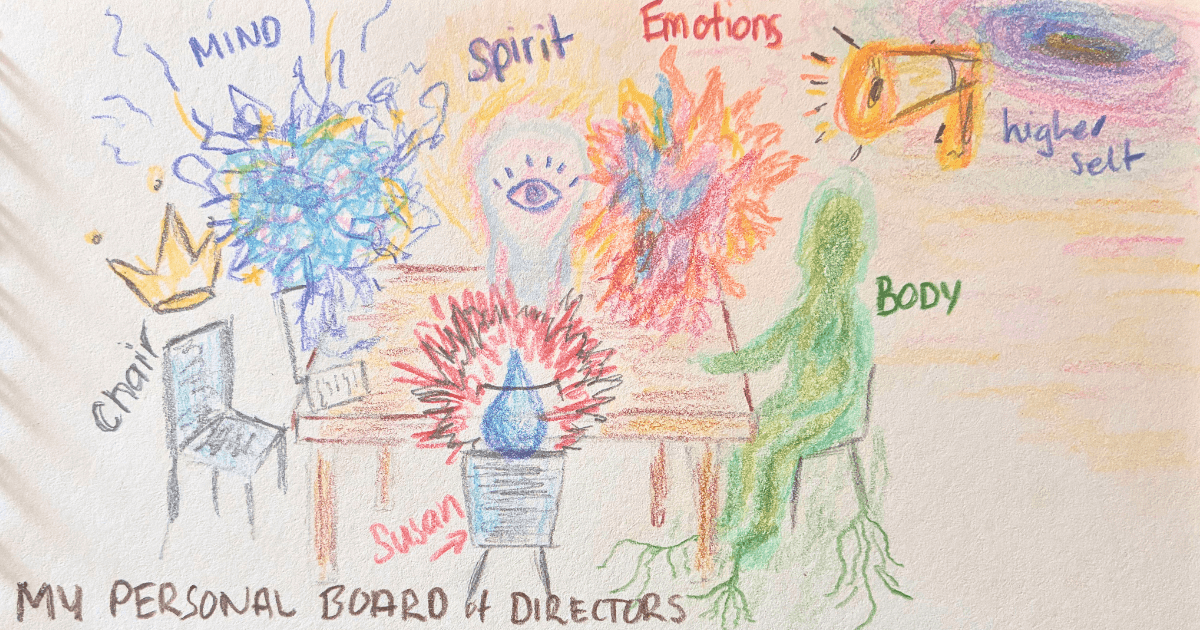
Picture a boardroom table with a seat for every part of you that has a stake in your life. Because they all do, and they’re all going to react whether or not you bother to invite them.
At my table there’s:
Body
Mind
Emotions
Spirit
Higher self, an extension of Spirit, and a late addition to the table
And me, the chairwoman. My job isn’t to have the best ideas. It’s to run a good meeting, make sure everyone gets heard, translate between them, and practise a bit of discernment about what we actually do next.
And then there’s Susan...
Susan gets her own heading
Susan is the voice of self-doubt and insecurity, and she sits at the table too, because funnily enough, ignoring her doesn’t work. Oh, how I have tried. Oh, how I have failed.
On the surface Susan is a bit of a Karen. Spiky, abrasive, an all-round negative Nelly. If I’m lying awake at 11pm questioning whether my friends even like me, that’s Susan. No surprises that luteal phase is her favourite time of month, it’s like someone has handed her a megaphone.
Underneath it all though, she’s really just a small, wounded child who hasn’t learned how to express her needs yet, so instead she throws a tantrum. She’s like a smoke alarm, loud and often set off by burnt toast rather than an actual fire, but wired, essentially, to keep me safe.
She’s a pain in the ass, but if Susan doesn’t feel safe, it isn’t happening. So I don’t try to shush her anymore without first listening to what she has to say. I raise the floor, not the ceiling. I ask what she needs to feel safe enough to let the change through.
If you recognised your own Susan in that, this whole publication is for you.
Everyone has different needs, language and static
Each seat at the table has three things I’ve had to learn:
what it needs to function
how it talks to me
what muddies the signal, making it harder to hear and understand.
Body needs a variety of movement, real food, rest, sunlight, sleep, hydration. It talks to me through sensation, tension, energy, that dropping feeling or that light one. Its signal gets muddied by artificial light, noise, processed food, chronic stress, not enough sleep, and not enough time outside.
Mind needs learning, a challenge, room to think, changing environments, new perspectives from books, travel, meeting new people, and a balance of stillness to file and process all of the new. It talks in thoughts and plans and the occasional 3am spiral. Its signal gets muddied by over-consuming content and marinating in other people’s opinions, until I genuinely can’t tell which thoughts are even mine. This usually happens when I’m not getting enough new perspective through actual experience, or when I’m not allowing time for it to file away the day.
Spirit is fed by the ocean, yin yoga, philosophy, time in nature, time for self-reflection and self-care, things that inspire awe, quality time with quality people, relishing good food and beauty. Anything that falls under ‘whimsy’. It talks in gut feelings and where the energy sits in my body. Its signal gets muddied by busyness, and by living entirely in the measurable.
Emotions are nourished by feeling loved, quality time with friends, cuddles, animals, anything that produces oxytocin. They need to be felt and acknowledged, not managed away. They talk first and loudest, often through my body, and they’re nearly always pointing at something true, even when the volume is unhelpful. They get muddied when I rush past them, or talk myself out of them because they’re inconvenient.
Susan is intentionally left off this list, because she communicates through whatever means necessary, mostly emotions and mind, and her need is simple: to be seen, heard and acknowledged. She needs me to respond, in case this is the one time there’s actually a fire. Once I’ve applied a bit of discernment and checked it out, I let her know we’re safe and we can carry on. At least until the next piece of burnt toast.
My higher self doesn’t sit in this table of needs either. She’s an additional voice who shines through with very direct authority, kind of like a wise grandma who is not to be ignored. She only comes through in urgent moments, or at the two extreme ends of the spectrum, when I have been ignoring all other signals and I am headstrong down the wrong path, or when I’ve managed to keep a really nice balance of listening to all of the things.
I could keep going, and across my writing, I will. But that’s the shape of it.
Before any meeting, I check the room
In my day job, before a co-design session, I never just launched in. I’d restate what we were actually there to do. I banned jargon and made sure everyone felt safe and confident enough with one another to speak up when they disagreed or didn’t understand. I made sure the conditions were supportive; are there snacks, is the room too cold, have we scheduled enough breaks, is it a good time of day when people still have energy (a 3pm meeting is no good for anyone).
I do the exact same thing with myself now. Before I try to change anything or make sense of something confusing, I check the room. Am I nourished, hydrated, and feeling safe? If not, that’s the top priority. You cannot renegotiate your whole life from inside a nervous system that’s convinced it’s under attack.
Sort the floor, then talk about the ceiling. If your basic needs aren’t met, deal with that first.
What this means for everything I write
I’m not here to hand you my table and tell you to copy it out. Yours will look different. Different representatives, different needs, different noise.
So that’s what all of this is really for. It’s my intention that everything I write is here to help you experiment with three questions of your own:
What are my signals? What is each part of me actually trying to say, and how do I tell them apart?
What’s my noise? What’s scrambling those signals, and where is it coming from?
How do I work with it? What actually helps me hear myself, turn the noise down, and give each part what it needs?
I’ll share what I’ve tried, what worked and what didn’t, and how things have changed for me over time. You get to run your own experiments and keep only what fits.
Practical note: my articles are tagged under body, mind, spirit, emotions or ‘the noise’, so you can follow whichever thread you need, or subscribe and see what resonates when it lands in your inbox. It’s free.