Con Fuego
5 years of vedic meditation, with the consistency of a drunk raccoon
One of my strongest tools in 'regulating my nervous system', despite showing up inconsistently. She's a gift that serves no matter what.
Before we jump into story time, let me explain that I have a small bee in my bonnet around the term 'regulating my nervous system'. I am getting tired of the content shoved down our throats that we need to regulate, as if dysregulation is a personal flaw we must each fix on our own to be an approved functional adult. It's the wellbeing version of Kim Kardashian curves, and the Ozempic era of it is surely coming. Of course we are dysregulated. We are in late-stage capitalism, the world is a bit of a dumpster fire, and we are living inside a system designed to disconnect us from ourselves and each other, then sell us the next range of products that will 'fix us'. The ever-increasing rates of anxiety, depression, languishing and overall discontent are a reasonable response to the shit show IMO.
But alas, regulating our systems does actually help with managing where the world is right now. What it is doing is expanding your capacity of what you can handle before things get overwhelming and you start being reactive or to disassociate.
A regulated nervous system is not being serene and calm all of the time.
A regulated nervous system is having the capacity to stay present with what is happening around you and respond to it, instead of react.
Having a regulated nervous system does not mean protecting your peace at every cost.
For me, as the girly who was buuuurrrnt out (honestly absolutely fried like a frizzled little wire), Vedic meditation was one of the many things I introduced in my life that helped me to claw my way out of a cold, dull hole. It was a massive element in the journey of rebuilding the connection I have with myself to identify my needs independent of what is being aggressively marketed towards me in every way, and once that connection with self comes back, connection with others follows and fuck me… It. Is. Fabulous!
Anywho, allow me to step off my soapbox and introduce vedic meditation.
What is Vedic meditation?
Vedic meditation is said to have been around for over 5,000 years. It comes from the Veda, the ancient body of Indian knowledge that yoga and Ayurveda also come from.
The actual practice is pretty simple, you get given a mantra, a sound that doesn't mean anything in any language, and you repeat it silently in your head for 20 minutes, twice a day.
That's it. You're not visualising anything, you're not trying to think your way into calm. You definitely aren't sitting stiff as a rod trying to pretend you are zen while your knee is screaming at you that it doesn't like sitting like that and a fly keeps landing on your nose.
You just do your best to continue with the mantra and once you catch yourself lost in a thought you shift your awareness back to the mantra.
What drew me to it compared to other forms of meditation
- You can get as comfortable as you want, the objective is to fully focus on what's happening so if you wanna sit in a cosy chair… amazing. Some people who are far more utilitarian than me can do it anywhere, in the car for a quick 20 mins before work. For me, unfortunately, no. I'm a girl that likes everything to be simultaneously practical and beautiful. In every space I have a cosy favoured chair or spot that is my 'meditation spot', and it must be equal parts beautiful and comfortable to entice me there.
- The whole point is to let your thoughts go, right? In order for them to go they first must come out of whatever deep dark crevice they are hiding in. So, you are not failing if your thoughts pop in, that's the whole point, they arrive… you observe… you get lost in a tangent of thoughts… you eventually think 'oh shit, that's right… I'm meditating.' And you come back to your mantra.
Why it works no matter how you do it, and has benefits even if you are inconsistent
This was beautifully described to me by my teacher with a visual, now I shall also share via my beautiful drawing skills.
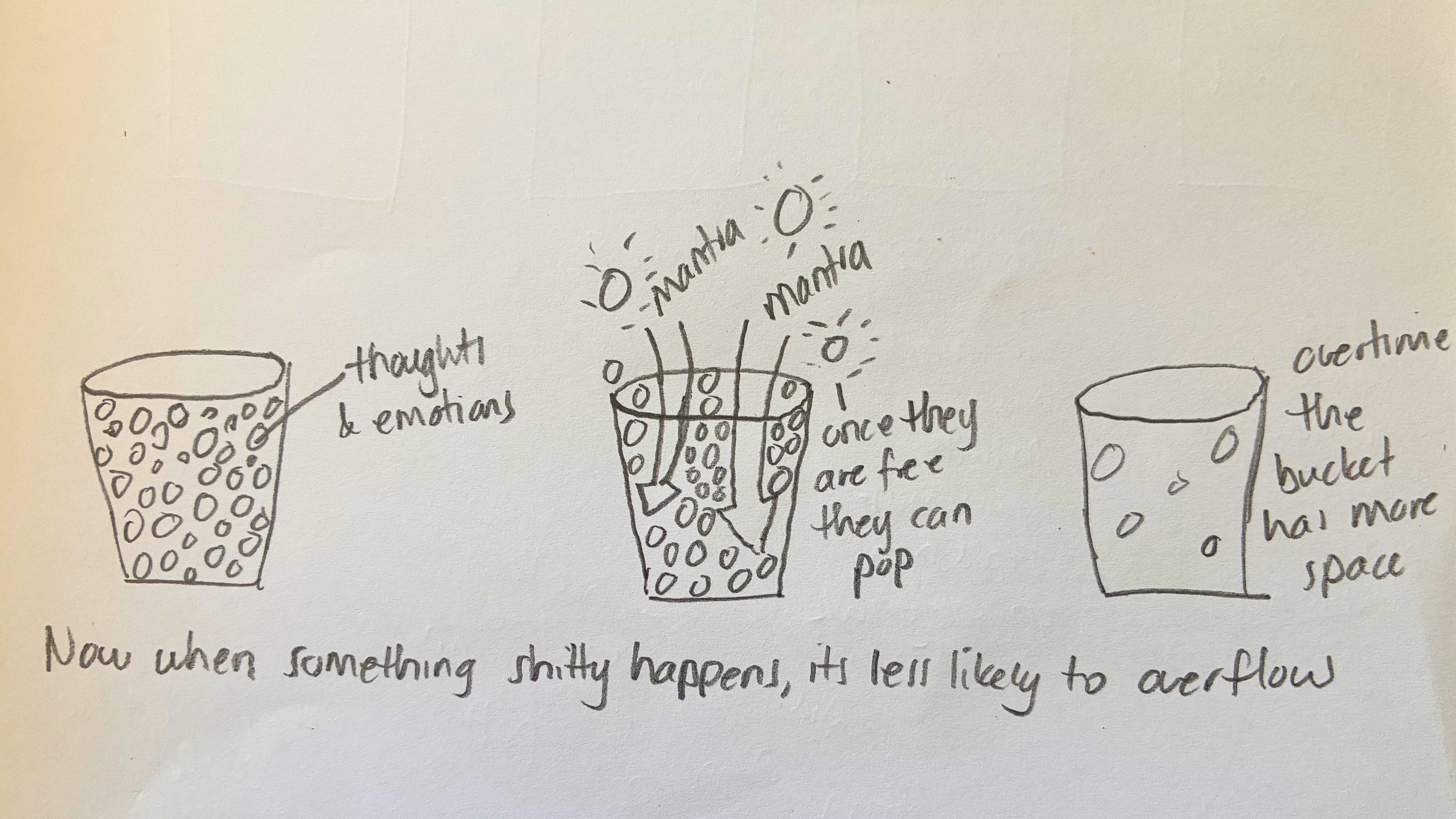
In short: your bucket is full of unprocessed thoughts and emotions. The mantra loosens them, they rise, they pop, and over time the bucket has more space, so when something shitty happens you're far less likely to overflow.
Since then, as I have learned more and more about fascia, I view it more like having a webbed system of really dirty water. You start pouring clean water in but it takes a lot longer than you expect for it to start to even get closer to running clear. I picture this as running through the entire webbing of our fascia, sometimes it hits blockages and the pressure needs to build against something before it gets dislodged.
The more consistent you are, the quicker it clears. The longer you have off, the longer the backlog you have to work through before you get closer to the benefits that come from consistency.
My personal experience with it
In the 5 years I've had this tool we have gone through every stage of attachment more than once. I have gone through periods of clinging to it like a lifeline, top of the priority list like it could save me from drowning. To completely forgetting about it for months and struggling to bring it back into my rotation, doing my best to ignore the call that it's needed. I kind of picture it like going on a trail run through a mountain range. Sometimes it's a fucking slog, sometimes you are on a slight downhill, the wind is in your hair, everything is beautiful and you feel like a superior being, and then all of a sudden you reach another incline and the only way to make it through is to disassociate slightly or cry.
Where I was to where I am now
It's hard to write about where I was at in that point of my life but I know it's the part that's relatable. My life and my essence could not have changed more since then. I went from being always stressed, waking up scared and stressed at 3am and not getting back to sleep, my body was physically unwell, my connection with myself was non-existent, I was uncomfortable with who I was, with my own thoughts, with everything. The best way I can explain it is that I was just overwhelmed all of the time. My days were something to be survived, not enjoyed. For a long time my hormones were out of balance, my skin was shitty, my periods irregular, despite diet and exercise I looked inflamed all of the time. I relied on substances to be able to have a break or have fun, I couldn't handle my own thoughts, always needing to be reading with music on or a podcast and my answer to everything was to take on more. My plate was overflowing and I had absolutely no idea how to stop taking on more. I was cramming my days with new routines and putting pressure on myself when these new things weren't a magical solution, convinced I was doing something wrong. What I was doing wrong was continuing to drown out my own voice and overwhelming myself with external solutions.
Everything at that time was grey and dull. It was like I was living inside a tiny grey bubble, slightly removed from the world around me, my senses muted, my capacity for feeling or for connection with anyone, including myself, just non-existent. I had been disconnected from myself for so long that I didn't even realise how far I was from hearing the things my body and spirit were trying to tell me. Hell, looking back at photos, I even looked grey. My skin was dull, my hair was thin and unhealthy, and my expression was worried and sad even when I was smiling. It's like I was wearing a translucent mask, and in the right lighting you could see straight through it.
Before you read on to how things have changed for me since implementing meditation, know it isn't the only piece of the puzzle. I am not selling this to you as some magical solution. I have been BUSY in that 5 years, but I am confident, based on the personal evidence from each time I have dropped it and then picked it up again, that it is a key player in the stability of my physical, mental and spiritual health nowadays.
Since bringing it into my practice my resting heart rate has consistently dropped each year (we have officially run out of room to go lower), my capacity for discomfort is so much higher, and I can stay present even in the most painful or uncomfortable of situations. I feel more alive and connected. The connections and opportunities for life that have come into my life since then have been insane and my self-trust and relationship with myself is always growing. There are situations I have been in that I know would have overwhelmed the fuck out of me of 5 years ago, I would have been rattled for weeks and outsourcing my coping to external distractions. Every time I'm in the middle of one of those moments, I pinch myself at how far I have come and throw a big thank you and a warm hug to the version of me who took the steps to get us to this point.
So how did we get here? Back to the very start.
Phase one: anxiety and chaos
When I very first started with the practice. In those early months I clung to it like it could single-handedly save me. I'd been in fight or flight for a couple of years I was completely fried. I had spent years doing everything possible to avoid silence and sitting with myself, so those early days stirred up full body chaos and anxiety, driven by fear that slowing down for even a moment would lead to…I don't even know what. At the time it felt like the end of the world. My micromanaging anxious inner Susan was struggling to give up control because she had no trust that me and my body were capable of coping. She was throwing an absolute fit that was very hard to ignore. The only way I managed to push past all of that was courtesy of the many warnings and repetition from my teacher throughout the training that the start is hard, reinforcing how worthwhile it is to continue past that point, plus a check in call a couple of weeks in to remind me directly that I am not failing, it's just hard to implement something new.
Phase two: extreme fatigue
Once I finally sat with the uncomfortable for long enough for it to be seen, we moved onto phase two: extreme fatigue. Sometimes I'd be so tired I wouldn't make it through a meditation at all, I'd curl up in a ball and sleep for HOURS. Other times I'd force my way through and then mostly sleep the rest of my spare time anyway. Fortunately, my teacher had warned me this could happen and told me to just go with it. After all, our bodies have no motivation to lie to us about needing rest, so don't be a dick and deny its request.
Phase three: emerging from the deep sleep
After perhaps a month of consistency and what felt like a long hibernation I started to ease out of my long winter. I remember going for a walk one day and actually making eye contact with people I passed and having a moment of connection. Such a small thing now but for so long in my grey bubble I truly felt invisible, not in that no one could see me but more of a 'if I can't see you, you can't see me' kind of energy. I was also so deep in my own head that even if I appeared to look at someone I wasn't actually seeing them.
Honestly this stage was something else. All of my senses felt the most awake they had been in years, colours were brighter, the sun felt warmer on my skin, I was thriving in the elements. I just felt alive. The bubble that kept me feeling removed from everyone around me and my senses dulled had been popped and now I was adjusting to life with full colour.
Phase four: space to find the next step
I have no idea how long it took but once my system got used to the full colours of life and I came out of that acute stage of fight or flight I eventually had some capacity for seeking out life again. At the start of this journey I had moved interstate and finally I was in a place where I had capacity for branching out and making friends, trying new hobbies and starting to settle.
What came with this was also the space to be able to see my next steps. As you probably gathered from so long living in a grey bubble, I was in need of some therapy. I was aware of this and had tried looking a few times but I could never find someone that felt like the right fit. I believe that I needed to get this first step out of the way to have enough safety within myself to find the right therapist and start that next part of my journey.
My first fall off the wagon (break from practice)
After about 6 months of practice I moved into a new environment that was less supportive of the rituals and habits I'd built around meditation. I went from having a lot of spare time and living alone to a pretty busy schedule and living in a share house. I wasn't used to having things competing for my attention and so I hadn't learned how I needed to actively protect and prioritise my meditation practice. I needed to find a new routine and schedule that fit with my new environment and that took a lot of trial, error and inconsistency. This has been a recurring thing each time I have had a major change in life circumstances: returning to full time work, each move to a new environment while slow travelling. Each time though it has gotten easier as I learn what does and doesn't work for me.
Return to practice #38748957? The one with endless tears.
Heads up, this part touches on losing a friend to suicide. Skip ahead to the next section if that's not for you today.
We are years in now. Meditation and I have split and reunited many times since the beginning. Sometimes intentionally, sometimes with guilt and other times without me even realising how much time had passed.
This particular return came after intentionally taking some time off. I'd recently lost a close friend to suicide. I was absolutely overrun with grief and felt that if I sat with it fully, the grief would completely consume me. Meditating seemed like the worst idea when I was trying to keep myself functioning to at least the bare minimum standard. At that point what I needed was to move those emotions I was actively experiencing… I needed A LOT of movement. So I surfed a fuck load (great sport for crying BTW), no one really notices tears running down your face when you're already red and bleary eyed from the surf. A few too many sniffles just has people assuming you've stacked it and had a few too many spin cycles in the washing machine.
So, months and months later, I decided I was ready to return to meditation. I was feeling like I had enough momentum that I wouldn't be completely derailed by a fresh wave of grief.
For the first few weeks back, within a few minutes of starting each meditation I would have tears streaming down my face, occasionally sobbing. Often it would be the release of tears and emotion but without any strong thought or connection to it, other times I was visited by all sorts of past grief experiences as if they had some fertiliser sprinkled on them from the new event. Years' worth of swallowed tears were resurfacing, only they didn't have the same weight as when you are deep in the experience of grief. They were just something that was there to be acknowledged and released.
When you are consistent, cool shit happens!
I think how this part shows up depends on how you perceive the world and how your brain works. Whether you are visual, audio, sensing etc. This is how cool shit has appeared for me.
Hearing cool shit
We all connect with ourselves in different ways. For me, my 'higher voice', future self, however you want to call it, is a bossy voice in my head. She carries the wisdom of a grandma with a take no bullshit attitude, it's how I differentiate her from the younger little gremlin voices that are incessantly chattering in my mind. When Grandma pipes in it's always with a sense of authority and one that is not to be ignored. It's never a wishy washy 'oh maybe I shouldn't do that because x, y, z self doubt driven made up problems', it's a firm 'No, don't do that' and she only pops in for the serious stuff. Sometimes I ignore her and every single time I learn.
I have a number of these inner voices worth listening to: my body, my emotions, my practical mind with the logic shaped by what we have learned, and then I also have the gremlins whom I am very fond of who just want to have fun, plus a gremlin or two that no one really likes who are the voices of self doubt and insecurity. I can typically keep the volume on those fuckers turned down by staying well rested and well nourished.
Meditation was the first time that I had enough quiet to get to know the voices, to differentiate them, understand where they are coming from and who they are representing. When you are forced to sit still for 20 minutes and someone is telling you something you might as well listen and get curious. Each compounding time this happened the connection I had with each of these elements of myself strengthened as I was finally able to listen and respond, and that started building trust with myself.
Seeing cool shit
When I have been really consistent, twice a day for an extended period, I start getting the occasional visual and that is cool. Somewhere in the summer of 2022/2023 a man's face popped in, along with a really strong feeling that I was in that moment with him. I could feel the presence of someone and the warmth of the connection as if I'd teleported to a completely different moment. This guy just felt so significant.
Obviously for a few months I was looking for this man everywhere I went, but eventually I completely forgot about it. Fast forward a few years, the visualisation long forgotten, and I start having intense moments of deja vu around a man who was indeed a very significant person in my life. The biggest of them was almost exactly the visual from my meditations. It didn't click straight away, then one night, in the middle of doing nothing, it did. The face I'd been shown years earlier was his.
You feel more, of everything
It gets so much harder to ignore what you actually need. I tend to get a bit carried away with life and live hard, at the expense of rest. When I reintroduce meditation at these periods my meditations tend to turn into a nap within 5 minutes. It's almost like you are signalling to yourself, OK this time is for you, whatever you need you may have, and whichever element of self is the most in need is the one that gets to pipe in. So those times where my physical needs have been the strongest that's what comes forward, a big firm 'you shall not deny me rest goddamn it!'. Same goes when my intuition is trying to come through.
What the research says
Vedic meditation has a trademarked cousin, Transcendental Meditation, or TM. They're essentially the same technique, TM is just the standardised, trademarked version taught through the official organisation. TM is the one with all the research behind it, so the studies below are technically on TM, but the mechanics of the two are close enough to accept the crossover.
- Lower blood pressure.1
- Reduced risk of heart attack, stroke and death in high-risk groups. A randomised controlled trial funded by the National Institutes of Health followed 200 people at high risk of cardiovascular disease over five years and found those practising TM had a 48% reduction in major adverse cardiovascular events compared to a standard health education group.2
- Reduced PTSD symptoms. In a randomised controlled trial with veterans, 50% of those practising TM no longer met the criteria for PTSD after just three months, compared to only 10% of the control group.3
- Improvements in anxiety and social functioning.4
- Slower biological ageing at the cellular level. A study looking at gene expression in people who'd practised for an average of 38 years found evidence consistent with the prevention or reversal of stress-related effects that are otherwise harmful to health, suggesting some benefits may compound the longer you stick with it.5
And it's not just the meditation crowd saying this. Back in 2013 the American Heart Association reviewed the evidence and concluded TM was the only meditation technique with enough behind it to be considered in clinical practice for lowering blood pressure. Every other technique they looked at, including mindfulness, didn't make the cut. In 2025 the AHA and the American College of Cardiology went a step further and named TM in their official high blood pressure guidelines, the first time any meditation practice has made it into that document.6
Full transparency though: a lot of the deeper studies, the PTSD and gene expression ones especially, come out of Maharishi International University, which is TM-affiliated, so it's not exactly a neutral party. The blood pressure findings are the ones that have been picked up and backed by independent bodies like the AHA. Make of all that what you will.
Then of course there are the endless anecdotal and self-reported changes from people who practise the method.
How do you learn it?
You need to learn through an accredited teacher. In order to become a teacher they must have been consistently doing the practice for at least 2 years. The people who share this tool have felt the benefits and massive impacts it's had on their lives and they want to share that with other people. I've met a few teachers now and they are all angels in random messy human form. The best of the best.
It depends on the teacher but for me I had the option of 4 evening face to face sessions from Monday to Thursday or doing it over a weekend. I chose the latter. The first session was one on one with the teacher in order to get my mantra and learn how to actually use it properly. The mantra itself is personal to you, and you're not meant to share it with anyone else, it's yours. Not to brag, but five years in and I've never once shared my mantra with anyone. It's still just mine.
If you're wondering how to actually find one, searching 'Vedic meditation teacher' plus your city will get you most of the way, and teachers' websites will tell you their course structure and pricing. Costs vary a lot by teacher and country, generally somewhere from a few hundred to over a thousand dollars, and many offer payment plans or sliding scales. It's a one-off cost for a tool you keep for life, which is a better deal than most of what the wellness industry is selling.
We are all wired differently and I am sure this is a tool that only works well for systems that fire a certain way. If you've been curious enough to read this far then perhaps this is something that would work well for you. If you feel a strong repulsion at the idea of meditating then it probably is almost definitely for you, just not yet.
Maybe, like my experience, it will plant a seed you don't even realise was planted, and in a few years' time when you are ready or there is a need there it will come back into your awareness like an already researched solution handed to you on a platter.
These articles are me sharing the things I once went searching for. I was a lost girl hunting for inspiration from women living lives that seemed authentically their own, and now I'm sharing what I've learned through a whole heap of trial and error.
So this is my ask for help: tell me what lands, what makes you curious, and what's waffle.
If something resonates and you want more, pleaaaaaase tell me.
Subscribing is free. Your engagement is how I learn what actually helps.
1. Anderson JW, Liu C, Kryscio RJ. "Blood Pressure Response to Transcendental Meditation: A Meta-Analysis." American Journal of Hypertension, 2008;21(3):310–316. A meta-analysis of nine randomised controlled trials found regular TM practice was associated with reductions of approximately 4.7 mmHg systolic and 3.2 mmHg diastolic blood pressure compared with controls, which the authors describe as clinically meaningful. pubmed.ncbi.nlm.nih.gov/18311126
2. Schneider RH, Grim CE, Rainforth MV, et al. "Stress Reduction in the Secondary Prevention of Cardiovascular Disease: Randomized, Controlled Trial of Transcendental Meditation and Health Education in Blacks." Circulation: Cardiovascular Quality and Outcomes, 2012;5(6):750–758. The trial followed 201 African American adults with coronary heart disease over an average of 5.4 years and found a 48% reduction in the composite of heart attack, stroke and all-cause mortality in the TM group. ahajournals.org
3. Bellehsen M, Stoycheva V, Cohen BH, Nidich S. "A Pilot Randomized Controlled Trial of Transcendental Meditation as Treatment for Posttraumatic Stress Disorder in Veterans." Journal of Traumatic Stress, 2022;35(1):22–31. At the three-month follow-up, 50% of veterans in the TM group no longer met PTSD diagnostic criteria, compared with 10% in the treatment-as-usual group. onlinelibrary.wiley.com
4. Orme-Johnson DW, Barnes VA. "Effects of the Transcendental Meditation Technique on Trait Anxiety: A Meta-Analysis of Randomized Controlled Trials." Journal of Alternative and Complementary Medicine, 2014;20(5):330–341. A meta-analysis of 16 randomised controlled trials with 1,295 participants found a moderate reduction in trait anxiety for TM compared with controls, with the largest effects in people who started with high anxiety. liebertpub.com
5. Wenuganen S, Walton KG, Katta S, et al. "Transcriptomics of Long-Term Meditation Practice: Evidence for Prevention or Reversal of Stress Effects Harmful to Health." Medicina, 2021;57(3):218. A gene expression study of practitioners with an average of 38 years of twice-daily TM practice, finding differences consistent with reduced risk of stress- and age-related disease. mdpi.com
6. Brook RD, Appel LJ, Rubenfire M, et al. "Beyond Medications and Diet: Alternative Approaches to Lowering Blood Pressure. A Scientific Statement from the American Heart Association." Hypertension, 2013;61(6):1360–1383. This statement concluded TM was the only meditation technique with sufficient evidence to be considered in clinical practice for lowering blood pressure. TM was subsequently named in the 2025 AHA/ACC high blood pressure guideline. ahajournals.org